Virtual Experience
- Ramya Chandran
- Mar 20, 2021
- 2 min read
Updated: May 13, 2021
A sample of the ideal experience of a temple space in a virtual environment

With respect to the stages of the tour, the routes remain true to those generally practiced, all of which are predetermined ancient practices. This was done not only to ensure relatability but also to facilitate the participants to relive their past experiences with the space. With respect to sensory stimuli, since the interaction is virtual, the design tools, namely 360 virtual experience and stories of heritage livelihoods, have been supplemented with a detailed route map and a key. The key indicates two major parts of the tour, i.e the taxonomy of experience and the sensory stimuli.

The taxonomy of experience
Inorder to clarify the sensorial aspects and explicitly detail the various elements that work towards activating a certain stimuli, a table illustrating the these aspects must be provided for the participants. This not only acts as a trigger, but also heightens their awareness of the holistic nature of the experience. This table, which is common for virtual and on-site experiences, has been given below. Correspondingly, the icons have also been illustrated in the tour map for ease of understanding for the participants.

The sensory features for each stimuli
At the first stage of the experience (route one), the participant is made to read about the various people who set up shop outside the temple spaces, selling flowers and other offerings which are purchased before entering the main temple ground. From the participant feedback, since the personal narratives were most impactful in triggering nostalgia, this form of storytelling must be used initially to draw them into the other curations in the tour.
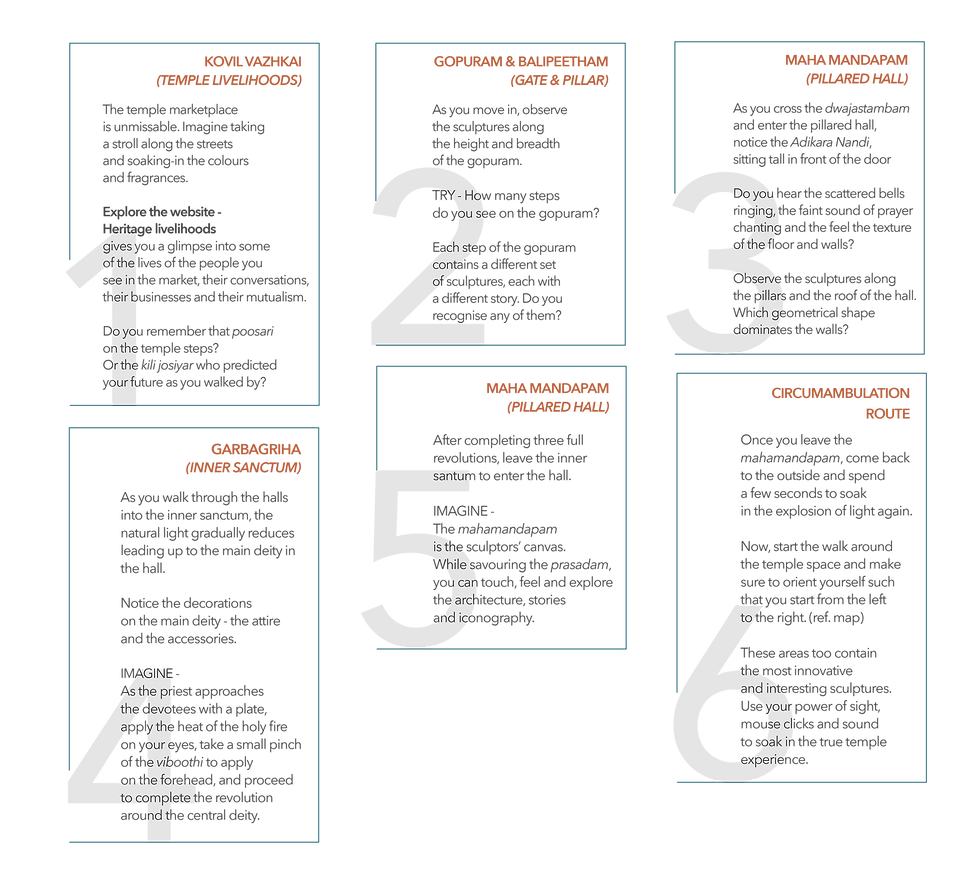
Route two to six will then be facilitated by the virtual experience, wherein at each point, the participant can stop, explore and click through to learn the semiotics of the sculptures and mythology behind the anthropomorphic figures. Needless to say, to truly bring the spaces alive whilst upholding the sensorial experiences, requires the use of multiple mediums such as audio, visual and text. This will also give the participants the option to decide how they can consume the content based on their preferences for absorption.
Comments